
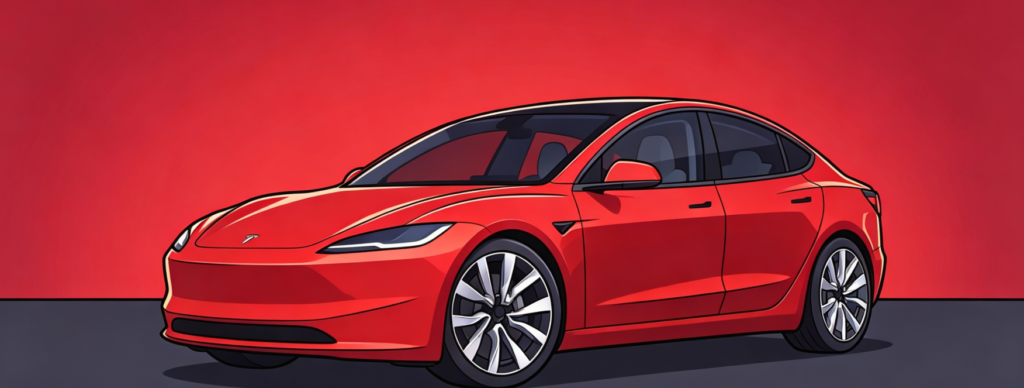
In the era of electrification, Tesla has revolutionized the automotive industry, and the Tesla Model 3 is one of the most influential electric vehicles in the world, making electric cars accessible to the masses. Launched in 2017, the Model 3 has quickly become the best-selling electric car globally, with over 1 million units sold, thanks to its excellent range, advanced technology, and affordable price. Unlike traditional gasoline-powered compact sedans, the Model 3 is fully electric, combining zero emissions, high performance, and intelligent technology, leading the transition from traditional fuel vehicles to electric vehicles.
The exterior design of the Tesla Model 3 is simple, sleek, and futuristic, with a minimalist design language that is unique to Tesla. The front face has no traditional grille (a signature of Tesla electric vehicles), with a smooth and streamlined shape that optimizes aerodynamic performance, with a drag coefficient of only 0.21, which is one of the lowest among compact sedans. The sharp LED headlights are sleek and modern, with adaptive high-beam functions, ensuring driving safety at night. The side body lines are smooth and clean, with a sloping roofline that extends to the rear, creating a coupe-like appearance. The hidden door handles and side air curtains further optimize aerodynamic performance, reducing wind noise and improving range. The rear part is simple and futuristic, with through-type LED taillights that are highly recognizable when lit, and no exhaust pipes (since it is an electric vehicle), emphasizing its zero-emission attribute. The overall design is minimalist and futuristic, suitable for users who pursue modernity and environmental protection.
Stepping into the interior of the Tesla Model 3, you are immediately greeted by a minimalist and high-tech atmosphere. The interior has no traditional physical buttons, with all controls integrated into a 15-inch central touch screen that is mounted in the center of the dashboard. The touch screen supports Tesla’s infotainment system, including navigation, entertainment, climate control, vehicle settings, and over-the-air updates (OTA), which can continuously upgrade the vehicle’s functions. The instrument panel is a small digital display behind the steering wheel, showing basic driving information such as speed, range, and battery level. The seats are made of high-quality synthetic leather (genuine leather optional), with good comfort and support, and the front seats support electric adjustment, heating, and ventilation functions (ventilation optional). The rear seats have sufficient legroom and headroom, and can be folded down to expand the trunk space. The trunk volume is 425 liters, and there is also a front trunk (frunk) with a volume of 150 liters, providing additional storage space. The interior is also equipped with a panoramic sunroof, which enhances the sense of space and brings more natural light into the cabin.
In terms of power and driving performance, the Tesla Model 3 offers three versions: Standard Range Plus, Long Range, and Performance. The Standard Range Plus version is equipped with a single rear motor, with a maximum power of 208 horsepower and a maximum torque of 375 N·m, a range of 445 km (WLTP), and can accelerate from 0 to 100 km/h in 5.8 seconds. The Long Range version is equipped with dual motors (all-wheel drive), with a maximum power of 346 horsepower and a maximum torque of 639 N·m, a range of 675 km (WLTP), and can accelerate from 0 to 100 km/h in 4.4 seconds. The Performance version is also equipped with dual motors (all-wheel drive), with a maximum power of 450 horsepower and a maximum torque of 750 N·m, a range of 628 km (WLTP), and can accelerate from 0 to 100 km/h in only 3.1 seconds, bringing supercar-level performance. All versions are equipped with a lithium-ion battery pack and support fast charging, which can charge from 10% to 80% in about 30 minutes with a Tesla Supercharger.
The Tesla Model 3’s driving performance is focused on smoothness, quietness, and responsiveness. Since it is an electric vehicle, it has no engine noise and vibration, providing a quiet driving experience. The electric motor delivers instant torque, making acceleration smooth and rapid, without the lag of traditional gasoline engines. The suspension system adopts a MacPherson strut front suspension and a multi-link rear suspension, which has good handling precision and body support, making the vehicle more stable during cornering. The vehicle is also equipped with Tesla’s Autopilot system (optional Full Self-Driving, FSD), which includes adaptive cruise control, lane keeping assist, automatic lane change, and automatic parking, reducing the driver’s fatigue and improving driving safety.
In terms of intelligent safety configuration, the Tesla Model 3 is equipped with a full range of safety features, including 8 cameras, 12 ultrasonic sensors, and 1 radar, which can perceive the road environment all-round. The Autopilot system (standard) can assist the driver in driving, and the Full Self-Driving (FSD) system (optional) can achieve more advanced autonomous driving functions (under specific conditions). In terms of passive safety, the vehicle adopts a high-strength aluminum alloy body structure, which has excellent crash resistance, and is equipped with front airbags, side airbags, curtain airbags, and knee airbags, providing all-round protection for drivers and passengers. The battery pack is installed at the bottom of the vehicle, which not only lowers the center of gravity, improving handling stability, but also has a protective structure to prevent battery leakage in collisions.
The Tesla Model 3 has changed the way people perceive electric vehicles, making them no longer just a niche choice but a mainstream option. With its excellent range, advanced technology, and high performance, the Model 3 continues to lead the development of the electric vehicle market, promoting the global transition to sustainable transportation.