

When the Lamborghini Miura made its public debut at the 1966 Geneva Motor Show, it did more than introduce a new car—it redefined the entire automotive landscape, creating the “supercar” segment and cementing its place as a timeless legend. More than six decades later, the Miura remains a symbol of technical radicalism, visionary engineering and breathtaking design, a testament to the courage and ambition of a young brand determined to challenge convention. To truly appreciate the Miura, we must explore its groundbreaking performance features and the fascinating story of how it came to life against all odds.
The Miura’s origin is a tale of youthful ambition and engineering audacity. In 1965, three of Lamborghini’s top engineers—Gian Paolo Dallara, Paolo Stanzani and Bob Wallace—worked in their spare time to develop a prototype known as the P400, against the initial wishes of founder Ferruccio Lamborghini, who preferred powerful yet sedate grand touring cars over race-derived machines. The engineers envisioned a road car with racing pedigree, one that could deliver unparalleled performance while remaining usable on public roads. When Ferruccio finally saw the prototype, he was instantly captivated and gave the team free rein to bring their vision to life, recognizing its potential as a game-changing marketing tool and a showcase of Lamborghini’s engineering prowess.
The Miura’s performance was revolutionary for its time, thanks to its groundbreaking mid-engine layout. It was the first Lamborghini to feature a transverse mid-mounted V12 engine, nestled behind the cockpit and ahead of the rear wheels—a design inspired by motorsport that would later become the standard for high-performance supercars. This layout kept the wheelbase short, enhancing agility, but presented engineering challenges, particularly with the gearbox, which required a unique casting to marry it with the engine seamlessly. The original P400 model featured a 3.9-liter V12 engine producing 350 CV at 7,000 rpm, while later versions—the Miura S and SV—saw power increases to 370 CV and 385 CV respectively, pushing top speeds to 290 km/h and making it the fastest production car in the world at the time.
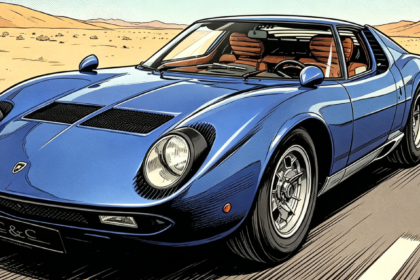
Design was another cornerstone of the Miura’s legacy. Crafted by Carrozzeria Bertone’s legendary designer Marcello Gandini, the Miura boasted sleek, timeless lines, a long low front, rounded headlights framed by “eyelashes” and an extremely low ground clearance (just 110cm at its maximum height) that exuded sportiness and elegance. The rear engine cover integrated with the trunk and rear wheel arches, while the slatted rear window not only added to its allure but also dissipated engine heat. Inside, the refined cockpit featured two recessed counters—the rev counter and speedometer—blending functionality with luxury.
Produced from 1966 to 1973, the Miura evolved through three main variants (P400, P400 S, P400 SV) and several special editions, with a total of 764 units built. It was more than just a car; it was a statement of Lamborghini’s core values—courage over convention, innovation without compromise—and it laid the foundation for the brand’s future success. Today, the Miura remains an icon, a reminder of what happens when engineers dare to dream and a testament to the power of visionary design and performance. To drive a Miura is to experience automotive history, and its legacy continues to inspire every Lamborghini built today.